Few artists in modern music history have managed to blend so many genres so effortlessly while consistently topping global charts. Bruno Mars is one of those rare talents who seems to do exactly that, captivating audiences with his smooth vocals, electrifying performances, and undeniable songwriting genius.
Whether you know him from the infectious groove of "Uptown Funk," the romantic balladry of "Just the Way You Are," or his record-breaking collaborations with Silk Sonic, there is no denying that Bruno Mars has cemented his place as one of the most versatile and successful musicians of the 21st century.
In this in-depth analysis, we will take you through everything you need to know about this remarkable artist. From his humble beginnings in Honolulu, Hawaii, to his rise as a multi-Grammy-winning superstar, we will explore his full biography, break down his impressive discography, and trace the defining moments of his career. By the end, you will have a clear and comprehensive understanding of what makes Bruno Mars such an enduring force in popular music.
Put on any Bruno Mars record and the first thing that hits you is not a genre. It is a feeling: bright, close-miked vocals sitting right up front in the mix, punchy brass stabs cutting through like a live horn section warming up in the next room, and a deliberate vintage warmth in the production that earns its retro textures rather than leaning on them for easy nostalgia.
That voice and those production instincts have built one of the most durable catalogs in modern pop. Mars now draws over 130 million monthly listeners on Spotify, a figure that reflects both deep catalog loyalty and intense current-moment momentum. His 2026 studio album, The Romantic, pulled in 26.44 million streams on its first day alone, according to Genius. The accompanying world tour set a Live Nation record with 2.1 million tickets sold in a single day and held the No. 1 position on Pollstar's Artist Power Index for eleven consecutive weeks. The scale of that response is not a comeback story; it is the confirmation of an artist who never actually left the room.
Peter Gene Hernandez was born on October 8, 1985, in Honolulu, Hawaii, and raised in the Waikiki neighbourhood in a household where music was not a hobby but a livelihood. His father, of Puerto Rican and Ashkenazi Jewish descent, performed Little Richard-style rock and roll; his mother, a Filipino immigrant, was a singer and hula dancer. The two had met performing together in a show, and their family band, The Love Notes, became young Peter's first stage. By age four he was performing five days a week with the group, including regular sets at the Sheraton Waikiki, and had already developed a convincing Elvis Presley impersonation that earned him the nickname "Little Elvis" in the Hawaiian tabloid MidWeek in 1990. That same year he performed in the halftime show of the Aloha Bowl, and by 1992 he had a cameo in the film Honeymoon in Vegas and an appearance on The Arsenio Hall Show at just six years old.
The influences absorb in those years run through everything he has made since: Elvis Presley, Michael Jackson, The Isley Brothers, The Temptations, Little Richard, Frankie Lymon, and Jimi Hendrix, who specifically inspired him to pick up guitar. His parents divorced when he was twelve, which ended The Love Notes, but the performance instincts were by then fully formed.
After graduating high school at seventeen, Hernandez moved to Los Angeles in 2003 to pursue a professional career. He signed with Motown Records in 2004, but the deal produced no releases, and the label dropped him the following year. The details of what material was recorded during that period remain undocumented in the public record. What is documented is the consequence: being cut loose from a major label with nothing to show for it pushed him away from the spotlight and toward the craft of writing songs for other people. It was at Motown, crucially, that he met vocalist and songwriter Philip Lawrence, the partnership that would define his next chapter.
The invisible-hand phase ended abruptly in 2010. Mars appeared as a featured vocalist on B.o.B's "Nothin' on You," which reached number one on the Billboard Hot 100, and on Travie McCoy's "Billionaire," for which he had originally recorded the hook as a demo reference vocal. McCoy kept it. The industry response to Mars as a solo presence was immediate. He had already signed with Atlantic Records in 2009, the label that would release every studio album of his career, from Doo-Wops and Hooligans in 2010 through to The Romantic in 2026, and the ground work laid during those invisible Smeezingtons years meant the transition from songwriter to frontman arrived fully armed.
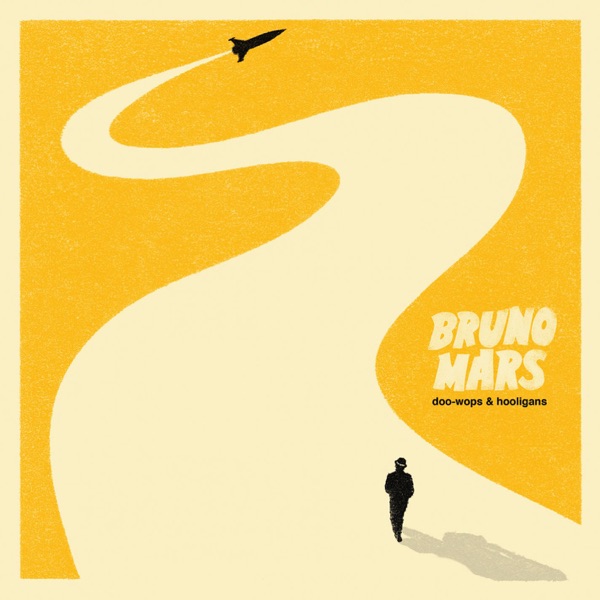
Doo-Wops and Hooligans: The Breakthrough (2010)
Released on October 4, 2010, on Atlantic Records, Doo-Wops & Hooligans announced Bruno Mars as a fully realized artist from its opening seconds. The album runs just ten tracks across 35 minutes, and that compression is a deliberate choice: the production, handled primarily by Mars and his collaborative team The Smeezingtons, strips away any excess to keep the listener locked onto the voice. Warm, close-miked vocals sit at the front of every mix, surrounded by textures that borrow freely from pop, reggae, soul, and old-school R&B without sounding scattered. "Runaway Baby" carries an old-school swing that recalls doo-wop's chest-thumping energy, while "Liquor Store Blues," featuring Damian Marley, drifts into lovers rock territory. The album sounds sun-lit and intimate rather than stadium-ready, which made it land harder in headphones than most debut records have any right to.
The lead single "Just the Way You Are" reached No. 1 on the Billboard Hot 100 and has since accumulated 3.4 billion Spotify streams, placing it among the most enduring debut singles in the streaming era. The song earned Mars a Grammy Award for Best Male Pop Vocal Performance, a recognition that pointed at something specific: the vocal performance itself, not just the songwriting. "Grenade," the album's emotional counterweight, also climbed to No. 1 on the Hot 100, demonstrating that Mars could sustain melodic precision across wildly different emotional registers within a single ten-song sequence. The album debuted at No. 3 on the Billboard 200 and has since been certified 9x Platinum in the United States, with over 16 million copies sold worldwide, a commercial footprint unusual for a debut.
Two pre-album releases, the It's Better If You Don't Understand EP and the "Liquor Store Blues" EP, had seeded the audience before the full-length arrived. By the time Doo-Wops & Hooligans dropped, Mars already had songwriting credits for Brandy, Natasha Bedingfield, and Cobra Starship, and had been performing professionally since childhood in Hawaii. That backstory explains why the debut sounds less like a promising first attempt and more like the work of an artist who had been rehearsing for it for years.
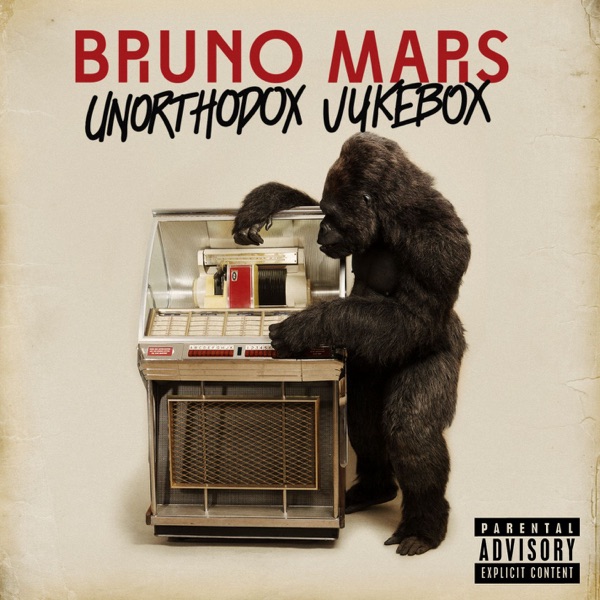
Unorthodox Jukebox: Genre Without Borders (2012)
Released on December 11, 2012, on Atlantic Records, Unorthodox Jukebox arrived with a title that functioned as a creative manifesto. Where most artists consolidate a signature sound on their second album, Mars did the opposite. The record moves from reggae-tinged new wave to stripped piano balladry to Prince-influenced funk to doo-wop closer, not because the project lacked focus, but because the genre-jumping was the point. The sequencing itself carries an argument: that Mars belonged to a tradition of American popular songcraft broad enough to hold all of it.
"Locked Out of Heaven" opened the album's commercial run and immediately established the scale of what was coming. Built around a jagged, Police-influenced guitar riff and a new wave rhythmic pulse, the track crackles with a nervous energy that feels distinct from anything on Doo-Wops & Hooligans. It reached No. 1 on the Billboard Hot 100 for six consecutive weeks and has since accumulated 3.4 billion Spotify streams, making it one of the most enduring singles in his catalog. The official music video has passed 1.28 billion YouTube views. The song announced, clearly, that Mars had no intention of repeating himself.
The album's most structurally daring moment arrives roughly at its midpoint. "When I Was Your Man" strips everything away: just Mars at a piano, singing a regret-soaked ballad with a melodic directness that owes more to classic Brill Building songwriting than to anything on pop radio in 2012. The arrangement offers nowhere to hide, and Mars does not need it. The track reached No. 1 on the Hot 100 and currently holds 3.2 billion Spotify streams. That two songs as sonically different as "Locked Out of Heaven" and "When I Was Your Man" both peaked at the top of the same chart, from the same album, is a more persuasive demonstration of range than any critical review could provide.
The wider tracklist reinforces the pattern. "Treasure" rides a funk-pop groove with a production palette borrowed from early 1980s radio. "Gorilla" leans into a heavier, Prince-adjacent intensity. "Young Girls" opens the record with a soft, doo-wop-inflected gentleness that makes the eventual blast of "Locked Out of Heaven" hit harder by contrast. The album accumulates 9.3 billion total Spotify streams across its catalog, reflecting not just the singles' reach but genuine engagement with the full sequence.
At the 56th Grammy Awards in 2014, Unorthodox Jukebox won the Grammy Award for Best Pop Vocal Album. The album was subsequently certified Diamond in the United States by the RIAA, representing sales and streaming equivalents of ten million units or more. With 24.8 million equivalent album sales under the CSPC methodology, it remains Mars's second best-selling release behind only 24K Magic. The full album audio continues to accumulate views on YouTube more than a decade after release, a marker of catalogue durability that most artists from that era cannot match.
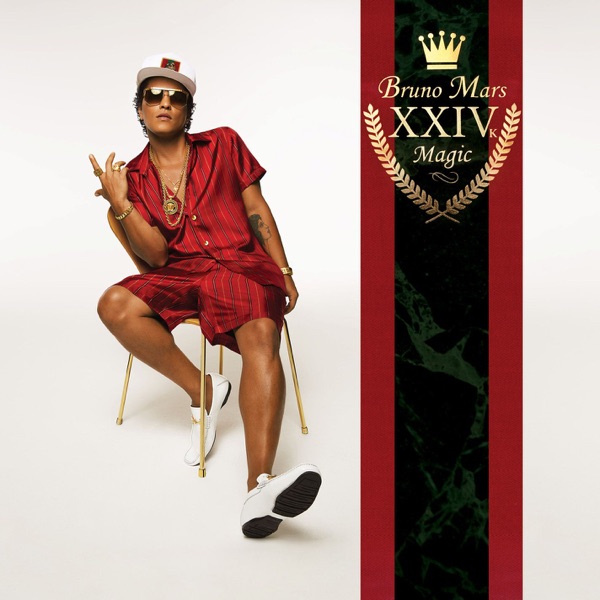
24K Magic: The Funk Maximalist (2016)
Released on November 18, 2016, 24K Magic arrived four years after Unorthodox Jukebox and represented the most fully committed version of Mars's funk and R&B instincts to date. Where his earlier records borrowed from multiple eras simultaneously, this one locked in on a single aesthetic target: the dense, pleasure-maximizing sound of late-1970s and 1980s Black pop, rebuilt from the drum kit up. The production, handled by Mars alongside his core unit Shampoo Press & Curl, comprising Mars, Philip Lawrence, and Christopher Brody Brown, plus collaborators The Stereotypes, prioritized physical impact at every turn. Floor-tom-heavy drums hit with a satisfying thud rather than a digital snap; layered synth brass creates the sensation of a full horn section even when synthesized; bass lines borrow the rubbery low-end logic of the Minneapolis sound associated with Prince and Jimmy Jam and Terry Lewis; and Mars's vocals are mixed warm and close, so intimate that the listener feels placed directly in front of him rather than at the back of an arena.
The album's title track, released October 7, 2016, announced this direction immediately. Its opening moment, delivered by Byron "Mr. Talkbox" Chambers on talk box, set a nostalgic yet contemporary tone that the rest of the record sustained for nine tracks. The song peaked at number 4 on the Billboard Hot 100) and has been certified 5x Platinum by the RIAA, with its music video surpassing one billion YouTube views by June 2018, roughly twenty months after release.
The album's commercial peak arrived through two different releases. "That's What I Like," a smooth mid-tempo groove built on stuttering synth chords and a near-conversational vocal delivery, reached number 1 on the Billboard Hot 100 and has since accumulated 3.3 billion Spotify streams. According to Billboard, it became the first song by a Black solo male artist to top both the Pop Airplay and R&B/Hip-Hop Airplay charts simultaneously since 1983, a statistical distinction that speaks to how broadly Mars's sound travels across radio formats. The second commercial anchor was "Uptown Funk," a collaboration with producer Mark Ronson that was released in November 2014, ahead of the album era, but became inseparable from it in public memory. That track spent 14 weeks at number 1 on the Billboard Hot 100 and has accumulated 5.8 billion YouTube views, making it one of the most-watched music videos in the platform's history.
The album's cultural moment was confirmed in January 2018, when 24K Magic was nominated in all six Grammy categories for which it was eligible and won all six at the 60th Annual Grammy Awards. Those wins included Album of the Year, Record of the Year for the title track, and Song of the Year for "That's What I Like," making it one of the most decorated single nights in Mars's career. The production team from The Stereotypes also earned Grammy recognition, reflecting how collaborative the album's sonic construction had been throughout. Before the album's promotional cycle was complete, Mars had performed at the 2016 American Music Awards, the 2016 Victoria's Secret Fashion Show, and, in February 2016, the Super Bowl 50 halftime show, where he shared the stage with Beyoncé and Coldplay. He had previously headlined Super Bowl XLVIII in February 2014, placing him among a small number of artists to headline the show on two separate occasions.
Silk Sonic, Las Vegas, and the Long Pause (2016 to 2025)
After 24K Magic wrapped its world tour in 2018, Bruno Mars did not retreat from music. He redirected. The next seven years were defined not by solo albums but by a deliberate shift toward collaboration, live residency, and selective partnership, a strategy that kept him at the centre of popular music without releasing a single album under his own name.
The most significant creative output of this period came through Silk Sonic, the duo Mars formed with rapper and drummer Anderson .Paak. An Evening with Silk Sonic, released on November 5, 2021, was not a conventional pop album. The project framed itself as a broadcast from a fictional retro soul-radio station, complete with an in-character MC persona, orchestral string arrangements, and production that consciously reconstructed the warmth and grain of 1970s Motown and Philadelphia soul. Every sonic choice was considered: the reverb on the snare, the close-harmony vocal stacks, the way the horns sit just behind the beat. It was nostalgic in construction but precise in execution.
The debut single, Leave the Door Open, reached No. 1 on the Billboard Hot 100 and won both the Grammy Award for Record of the Year and the Grammy Award for Song of the Year at the 2022 Grammy Awards. Winning both categories with a debut single from a side project was a rare achievement, and it confirmed that the Silk Sonic experiment carried the same commercial and critical weight as any Mars solo release.
In August 2024, Mars released "Die With a Smile" alongside Lady Gaga, a standalone collaboration outside the Silk Sonic project. The song's production marked a deliberate shift from his funk-driven instincts: slow-building orchestral swells, a ballad structure, and a pairing of two singers whose vocal registers complement rather than compete. Lady Gaga and Bruno Mars won Best Pop Duo/Group Performance at the 2025 Grammy Awards for the track. By mid-2026, it had accumulated 3.876 billion Spotify streams, making it his most-streamed song of all time and placing it ahead of every legacy hit in his catalog, including "Locked Out of Heaven" and "Just the Way You Are."
Throughout this entire period, Mars also maintained an extended residency at Dolby Live at Park MGM in Las Vegas, with additional dates still being added as late as August and September 2025. What fans sometimes described as a decade-long gap was, in measurable terms, consolidation. Residency performance, collaborative releases, and the sustained streaming dominance of "Die With a Smile" kept Mars ranked among the most-listened-to artists in the world, all without a solo studio album in release.
The Romantic: The Return (2026)
Released on February 27, 2026, on Atlantic Records, The Romantic) is Bruno Mars's fourth solo studio album and the record that ended a ten-year wait since 24K Magic. The gap had been widely noted across fan communities and music media alike, with Yahoo Entertainment framing the release as "highly anticipated" and pointing directly to the decade-long absence. Atlantic Records' own announcement video drew 4 million views, 267,000 reactions, and more than 1,400 comments within days, a figure that reflects how much pent-up demand had been building since 2016.
The album runs nine tracks across 31 minutes and 34 seconds, with a tracklist including "Risk It All," "Cha Cha Cha," "God Was Showing Off," and "Dance With Me." Compact by modern standards, the record prioritizes focus over length. A Spanish-language version of the lead single, titled Lo Arriesgo Todo, was released on vinyl, signaling a deliberate push into Latin markets. Spotify editorial designated the album's accompanying playlist as an Artist Pick on Mars's profile, placing it at the front of his page as an active platform-supported release.
The album is being supported by The Romantic World Tour, produced by Live Nation and described as Mars's first full headline stadium tour ever, a significant escalation from the arena-scale 24K Magic dates. The tour launched April 10, 2026, at Allegiant Stadium in Las Vegas, with Anderson .Paak serving as special guest on all dates under his DJ Pee .Wee alias. Confirmed venues span Rogers Stadium in Toronto, Wembley Stadium in London, MetLife Stadium in New Jersey, and SoFi Stadium in Los Angeles, with the total run covering nearly 40 shows across North America, Europe, and the UK.
The digital footprint surrounding the release has been measurable and sharp. A single-day spike of 118,329 new Spotify monthly listeners on July 27, 2026, representing a 2,900.2% increase above typical daily growth, points to the combined effect of the tour and album actively pulling in listeners who had not previously tracked Mars as a regular stream. For a catalog already sitting at over 130 million monthly listeners, that kind of daily movement is not routine. It indicates new audience acquisition, not just existing fans cycling back through familiar records.
Musical Style and Influences
Bruno Mars possesses a naturally high tenor voice that sits comfortably in a range most male pop singers avoid. What distinguishes him technically is not raw power but precision: his falsetto, deployed on tracks like "Grenade" and "When I Was Your Man," is controlled and emotionally exact rather than showy. He rarely oversings. On "That's What I Like," the vocal sits loosely in the pocket of the beat, more conversational than demonstrative. The effect is that the groove always leads and the voice serves it, which is a discipline closer to James Brown's philosophy than to the arena-pop tendency to let held notes signal emotion.
His production aesthetic draws from multiple decades without collapsing into pastiche. The compressed funk on 24K Magic traces directly to the Minneapolis sound of the late 1970s, where rhythm guitar and synthesizer lock together into a single percussive unit. The drum programming on "Treasure" borrows the clean, punchy snare that defined 1980s new jack swing. Underneath all of it runs a melodic directness inherited from Brill Building pop songwriting: verses that move without confusion, choruses that land on the first listen. Reggae supplies the rhythmic looseness that keeps tracks like "The Lazy Song" from feeling rigidly constructed.
Mars has cited Michael Jackson, James Brown, Elvis Presley, Bob Marley, and Prince as primary influences, and the specific quality that separates him from artists who simply name-drop predecessors is his ability to shift between these reference points across a single album's runtime. Unorthodox Jukebox moves from reggae-inflected verses to soul balladry to arena rock without the transitions feeling forced. That range is a direct product of his childhood: performing covers of all five artists before the age of ten gave him an internalized vocabulary rather than an academic one.
Lyrically, the catalog is more varied than casual listeners expect. "Just the Way You Are" and "Marry You" occupy the sunlit end of the romantic spectrum. But "Grenade" and "When I Was Your Man" operate on a different frequency entirely; both work precisely because the production warmth creates a tension with the lyrical content. The arrangement on "When I Was Your Man" is spare piano-and-vocal, which forces the regret in the words to carry full weight without melodic distraction.
His collaborative output confirms that he can subordinate his individual sound without losing it. "Uptown Funk" with Mark Ronson borrows his funk instincts but places them inside Ronson's harder-edged British production style. The Silk Sonic project with Anderson .Paak required him to build a shared voice with a co-equal creative partner rather than dominate the arrangement. "Die With a Smile" with Lady Gaga, now his most-streamed track on Spotify with over 3.8 billion plays, demonstrates a different skill: the ability to hold space beside a singer with an equally distinctive instrument, adjusting his dynamic to serve the duet rather than the solo.
Awards and Commercial Achievements
Bruno Mars holds 16 Grammy Awards in total, a tally built on two historic single-night sweeps. At the 2018 Grammy Awards, 24K Magic won all seven categories for which it was nominated, including Album of the Year, Record of the Year, and Song of the Year for "That's What I Like." That clean sweep placed 24K Magic among the most decorated albums in a single Grammy cycle. Four years later, as one half of Silk Sonic alongside Anderson .Paak, Mars won all four Grammy nominations at the 2022 ceremony, taking Record of the Year, Song of the Year, Best R&B Song, and Best R&B Performance for "Leave the Door Open." His broader awards haul extends to 14 American Music Awards, 4 Brit Awards, and 8 Guinness World Records.
The commercial data is equally substantial. Mars has accumulated 127.6 million CSPC equivalent album sales across his career, with 20 million in pure album sales and 149.6 million digital single sales. Nine of his songs have reached number one on the Billboard Hot 100. On Spotify, 47 individual tracks have surpassed 100 million streams, demonstrating that his commercial strength is spread across multiple eras rather than anchored to a single release. Total Spotify lead streams stand at 50.7 billion, and Bruno Mars became the first artist to reach 140 million monthly Spotify listeners as of late 2024, a figure that has continued climbing. As of 2026, he holds a Spotify popularity score of 95 out of 100, 130 million monthly listeners, 86.2 million Spotify followers, and ranks 6th globally across all artists and genres on Chartmetric.
Five Things Worth Knowing About Bruno Mars
Peter Gene Hernandez was the name on his birth certificate, but he became Bruno Mars before ever setting foot in Los Angeles. He adopted the stage name prior to leaving Honolulu after graduating from President Theodore Roosevelt High School in 2003, a deliberate reinvention that separated his professional identity from his given one. The choice proved prescient: Bruno Mars became one of the most recognizable names in contemporary pop.
Mars is among a very small number of artists to have headlined the Super Bowl Halftime Show twice, performing at Super Bowl XLVIII in 2014 and Super Bowl 50 in 2016. The two performances bracketed his transition from the Unorthodox Jukebox era into the funk-forward world of 24K Magic, giving him back-to-back defining live moments on the biggest broadcast stage in American sports.
His cultural footprint extends well beyond the United States. The Philippines ranks as his second-largest streaming market globally according to Chartmetric, a concentration of regional fandom that is unusual for a US-based pop artist. The biographical link is direct: his mother is of Filipino descent, and that connection appears to have translated into generational loyalty from Filipino listeners.
On TikTok, the numbers reveal something structural about how his catalog operates. Against 16.9 million direct followers, 96.7 million posts use his music, a ratio that indicates his songs function as raw creative material for a creator community far larger than his core audience.
The most striking recent data point belongs to "Die With a Smile," his August 2024 collaboration with Lady Gaga. With 3.876 billion Spotify streams, it has become his most-streamed song ever, overtaking both "Locked Out of Heaven" and "Just the Way You Are" despite arriving more than a decade after either track was released.
Frequently Asked Questions About Bruno Mars
What is Bruno Mars's real name?
Bruno Mars's legal name is Peter Gene Hernandez. He was born on October 8, 1985, in Honolulu, Hawaii, and adopted the stage name Bruno Mars before relocating to Los Angeles in 2003 to pursue his music career professionally.
What is Bruno Mars's most streamed song?
As of 2026, "Die With a Smile," his 2024 collaboration with Lady Gaga, is his most-streamed individual track with 3.876 billion Spotify streams. It sits ahead of two catalog staples that have each accumulated 3.4 billion streams: "Locked Out of Heaven" from Unorthodox Jukebox and "Just the Way You Are" from his debut album Doo-Wops and Hooligans.
Did Bruno Mars perform at the Super Bowl?
Yes, and he did so twice, which remains a rare distinction in the history of the halftime show. He headlined the Super Bowl XLVIII halftime show in February 2014, delivering a widely praised set noted for its tight production and live-band energy. He returned for Super Bowl 50 in February 2016, performing alongside Beyoncé and Coldplay at Levi's Stadium in Santa Clara, California.
What is Bruno Mars's new album?
The Romantic, released on February 27, 2026, on Atlantic Records, is his fourth solo studio album and his first solo full-length release since 24K Magic in 2016. The album is supported by a stadium world tour that held the No. 1 position on Pollstar's Artist Power Index for eleven consecutive weeks as of mid-2026.
What genre is Bruno Mars?
Mars works across contemporary R&B, funk, pop, soul, reggae, hip-hop, and rock, and no single genre label covers the full catalog. Each album reflects a different set of influences: Doo-Wops and Hooligans leans on pop and soul, Unorthodox Jukebox pulls from rock and funk, 24K Magic commits fully to 1980s funk and R&B, and The Romantic adds orchestral balladry to the mix. That range is a central reason his audience spans multiple demographics and generations.
Bruno Mars in 2026: Why He Still Commands the Room
The through-line of Bruno Mars's career is straightforward: every album has been a deliberate stylistic statement rather than a response to whatever sound was charting that quarter. From the doo-wop softness of Doo-Wops and Hooligans to the maximalist funk of 24K Magic to the neo-soul sweep of The Romantic, each record arrived on its own terms. That consistency of intent is what separates his catalog from peers who pivoted toward trends and then had to pivot again.
The Romantic and the 2026 world tour are not a comeback. They are a continuation. His catalog never stopped moving; with 82.6 billion total on-demand streams across all platforms and 47 tracks each surpassing 100 million Spotify streams, the audience never left. The Romantic Tour's eleven consecutive weeks at number one on Pollstar's Artist Power Index simply made visible what the streaming data had been recording quietly for years.
For readers who want to go deeper, MyBesh offers song-by-song lyrics, interpretations, and thematic analysis across all five studio albums and his major collaborations. Strong starting points include the MyBesh pages for "Die With a Smile," "When I Was Your Man," "That's What I Like," and An Evening with Silk Sonic, each of which represents a distinct phase of his artistic thinking. With The Romantic still supported by active touring and platform promotion through the second half of 2026, this chapter is ongoing rather than settled.
Conclusion
Bruno Mars is more than just a pop star. He is a generational talent whose journey from a young performer in Hawaii to a global icon proves that raw passion combined with relentless dedication can achieve extraordinary things. His genre-defying discography, record-breaking chart success, and electrifying stage presence have earned him a permanent place in music history. More importantly, his story reminds us that authenticity and artistry never go out of style.
Whether you are a lifelong fan or just discovering his music for the first time, there is always more to appreciate about Bruno Mars. Stream his albums from start to finish, revisit his classic live performances, and explore his collaborations with Silk Sonic. Once you dive deeper into his catalog, you will understand why the world simply cannot get enough of him.
 via depositphotos ↗



![Cover of The Twilight Saga: Breaking Dawn, Pt. 1 (Original Motion Picture Soundtrack) [Deluxe Version]](https://is1-ssl.mzstatic.com/image/thumb/Music115/v4/f5/2e/83/f52e8357-9cf4-e644-c365-3c21839f85ac/mzi.staekbjw.jpg/600x600bb.jpg)
![Cover of Finesse (Remix) [feat. Cardi B] - Single](https://is1-ssl.mzstatic.com/image/thumb/Music125/v4/56/df/33/56df332a-da4a-d565-f40e-960905ee1a2b/075679878892.jpg/600x600bb.jpg)