
30-sec preview
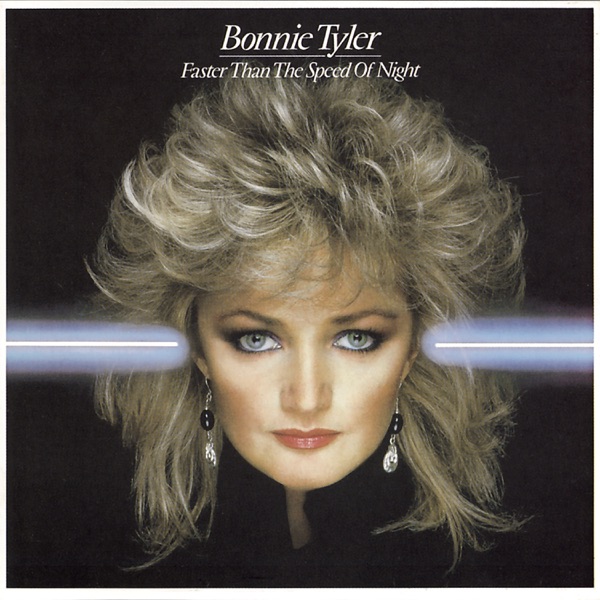
1983 · From the album Faster Than the Speed of Night
Total Eclipse of the Heart
by Bonnie Tyler
The reading
A woman who can't stop needing a lover who won't fully arrive, dramatised as an astronomical event happening inside her chest
02 · Interpretation
Bonnie Tyler's Total Eclipse of the Heart: Wanting Someone Who Won't Turn Around
The song begins with a single instruction repeated like a spell: turn around. Before the listener knows who is speaking or to whom, Bonnie Tyler is already asking someone to face her. That word, delivered over and over across nearly seven minutes, is the engine of the whole track. The narrator is not describing a relationship so much as pleading with a partner who is chronically half-absent, and the pleading itself has become the shape her love takes.
Released in February 1983 on Faster Than the Speed of Night, the song was written and produced by Jim Steinman, whose fingerprints (Meat Loaf's Bat Out of Hell, most obviously) are audible in every choice: the whispered verses, the multi-stage build, the church-organ solemnity giving way to power-ballad thunder. Steinman treats pop songs as three-act plays, and this one uses its length to enact the very thing it describes, a feeling that keeps escalating because it cannot resolve.
The verses: a catalogue of small collapses
Each verse ticks off a different mood the narrator falls into when her partner is not there: lonely, tired of hearing her own crying, nervous that her best years are behind her, terrified, restless and dreaming of something wild, helpless, angry enough to need to leave the house and cry. Steinman writes these as tiny confessions, each one prefaced by "every now and then," as though the narrator is trying to minimise how often it happens. The qualifier does the opposite; if you have to list this many now-and-thens, the feeling is constant.
Notice how the terror keeps getting interrupted by the look in the lover's eyes. It is offered as reassurance, but the structure suggests something less flattering: the only thing that stops her from unravelling is a glance, and she has to keep asking him to give it to her. Hence "bright eyes," the pet name that turns him into an object of worship and a source of light she cannot generate on her own.
The chorus: dependency dressed as devotion
When the song finally opens into its chorus, the language turns absolute. She needs him now, tonight, more than ever; if he only holds her tight they will hold on forever; together they can take it to the end of the line. The vocabulary is the vocabulary of ultimatum. Love here is not a steady state but a救 rescue that has to happen this evening or not at all. The line about their love being "like a shadow on me all of the time" is telling: shadows are cast by something blocking the light. Even in the chorus, the imagery keeps darkening.
Then comes the song's most quoted couplet, about living in a powder keg and giving off sparks. It reads as passion, but a powder keg is a thing waiting to blow itself apart. The narrator is naming the volatility, not celebrating it.
The title image
By the time she names the feeling, the metaphor has been fully earned. Once upon a time she was falling in love; now she is only falling apart. A total eclipse of the heart is a beautifully precise piece of writing: an eclipse is temporary, spectacular, and caused by one body getting between another and its light source. She has let this man become the sun and the moon at once, and the result is that she cannot see. She says outright that there is nothing she can do, which is the ballad's real subject. Not heartbreak, exactly, but the loss of agency inside heartbreak.
Why it endures
The song has survived four decades of karaoke and prom-night airplay because it treats a small, embarrassing feeling (needing someone more than they need you) with operatic seriousness. Steinman refuses to make it tasteful, and Tyler's voice, sanded down and grainy, sells the melodrama as lived experience rather than performance. Most love songs promise a resolution. This one stages a weather event and lets it pass over the listener, which is why people who are not currently in love still sing along at the top of their lungs. It gives the feeling somewhere to go.
Themes catalogued
03 · Lyrics
"Total Eclipse of the Heart"
Turn around
Every now and then I get a little bit lonely
And you never coming 'round
Turn around
Every now and then I get a little bit tired
Of listening to the sound of my tears
Turn around
Every now and then I get a little bit nervous
That the best of all the years have gone by
Turn around
Every now and then I get a little bit terrified
And then I see the look in your eyes
Turn around, bright eyes
Every now and then I fall apart
Turn around, bright eyes
Every now and then I fall apart
Turn around
Every now and then I get a little bit restless
And I dream of something wild
Turn around
Every now and then I get a little bit helpless
And I'm lying like a child in your arms
Turn around
Every now and then I get a little bit angry
And I know I've got to get out and cry
Turn around
Every now and then I get a little bit terrified
But then I see the look in your eyes
Turn around, bright eyes
Every now and then I fall apart
Turn around, bright eyes
Every now and then I fall apart
And I need you now tonight
And I need you more than ever
And if you only hold me tight
We'll be holding on forever
And we'll only be making it right
'Cause we'll never be wrong
Together we can take it to the end of the line
Our love is like a shadow on me all of the time
I don't know what to do and I'm always in the dark
We're living in a powder keg and giving off sparks
I really need you tonight
Forever's gonna start tonight
Forever's gonna start tonight
Once upon a time, I was falling in love
Now I'm only falling apart
There's nothing I can do
A total eclipse of the heart
A total eclipse of the heart
And I need you now tonight
And I need you more than ever
And if you only hold me tight
We'll be holding on forever
And we'll only be making it right
'Cause we'll never be wrong
Together we can take it to the end of the line
Your love is like a shadow on me all of the time (all of the time)
I don't know what to do, I'm always in the dark
We're living in a powder keg and giving off sparks
I really need you tonight
Forever's gonna start tonight
(Forever's gonna start tonight)
Once upon a time, I was falling in love
But now I'm only falling apart
Nothing I can do
A total eclipse of the heart
A total eclipse of the heart
A total eclipse of the heart
A total eclipse of the heart
Lyrics via Google. Copyright belongs to rights holders.
04 · FAQ